
Cohost is the fastest-growing Backend-as-a-Service company in the event management space, focused on large event organizers. Their marketing team had a problem: the prospecting tools they were using weren’t cutting it. They had a target list assembled through manual research and off-the-shelf prospecting tools, and the outreach was going out — but the results weren’t there. Their best prospects weren’t responding, and the team was spending too much time on research that still produced generic-feeling outreach. They asked us to build something better.
The Challenge
The signal-to-noise ratio on Cohost’s existing prospect list was bad. Identifying genuinely promising leads required hours of manual research per account — time their team didn’t have and couldn’t scale. Even when they put in that work, the outreach still had to be written, sequenced, and tailored to each contact. The manual ceiling was low and the opportunity in front of them was large.
The bigger issue was that their best prospects — large event organizers who’d be a natural fit for a BaaS platform — had already been burned by too much irrelevant outreach from too many vendors. A good email about a product they actually needed still got ignored, because it looked like everything else in their inbox.
Cohost didn’t need more volume. They needed outreach that was specific enough to cut through — and a way to produce that specificity at scale without a team of researchers.
What We Built
We built an end-to-end agentic pipeline that automated Cohost’s entire outbound process — from finding prospects to producing a fully sequenced, personalized outreach strategy for each one. The contractors handle the research and synthesis; the marketing team stays in control of what actually goes out.
The pipeline runs in five connected stages.
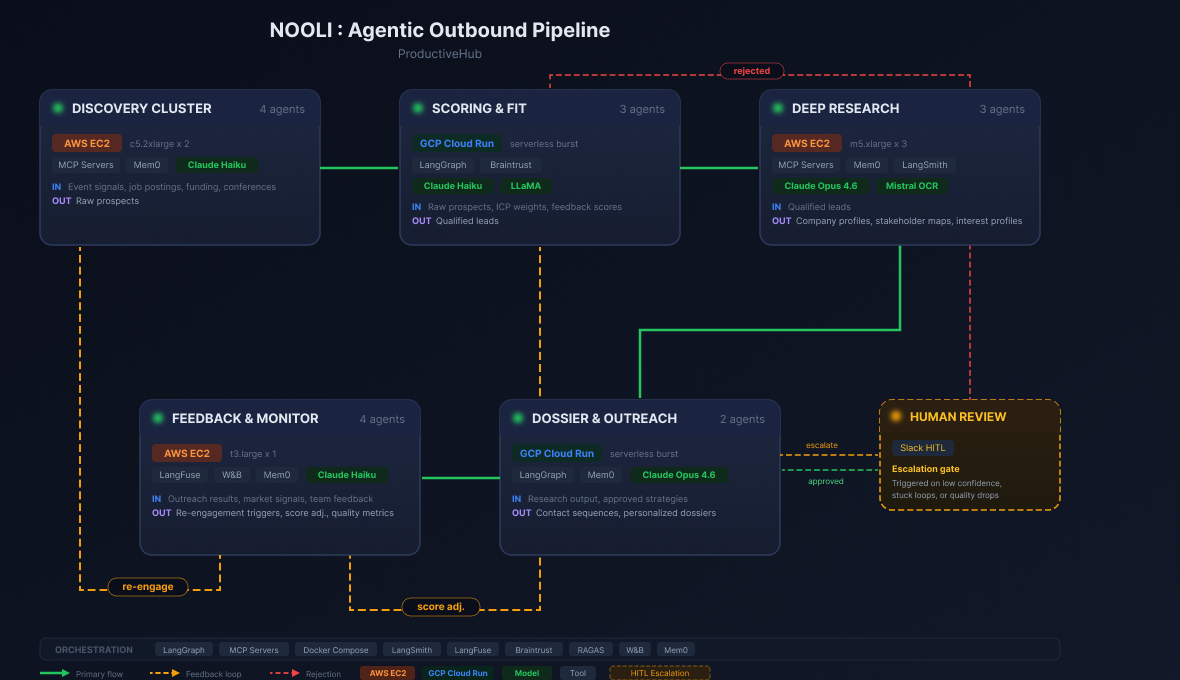
The first stage is continuous discovery. Always-on contractors scan the event industry for signals: job postings, funding rounds, conference announcements, and market activity that surfaces companies who are actively growing, changing, or experiencing the specific pressures that Cohost’s platform is built to address. This isn’t a one-time list pull — it’s a live feed of opportunity, updated constantly.
From there, candidates move into the scoring and fit engine. Each prospect is evaluated against Cohost’s Ideal Customer Profile using weighted, multi-factor analysis. Contractors that handle high-volume screening do so cost-efficiently at scale — the system was designed to score hundreds of prospects simultaneously without sacrificing quality at the top of the funnel.
Prospects who make it through scoring enter the deep research stage — the part that makes the whole system worth building. Dedicated contractors run extended research sessions on each account: company analysis, stakeholder mapping, personal interest profiling on key contacts, and a full picture of what the company has publicly communicated about their priorities. By the time a prospect reaches the outreach stage, the system has assembled a comprehensive view of who they are, what they care about, and what would make them pay attention.
That research feeds directly into dossier and strategy generation. Synthesis contractors produce a full outreach playbook for each prospect — not a single template, but a sequenced strategy across multiple touchpoints, with distinct angles for different stakeholders within the organization. Round one might address the operational pain. Round two might speak to a specific recent announcement. The outreach is built to evolve as the relationship develops, not to repeat the same message in a slightly different format.
Finally, the feedback loop closes the system. Every decision the marketing team makes — approving a prospect, rejecting a dossier angle, flagging an outreach sequence as off-target — is ingested back into the pipeline. Scoring weights and personalization heuristics adjust based on what the team tells the system is working. Each cycle refines the next.
From Discovery to Dossier: How the Pipeline Works
The infrastructure behind the pipeline was designed to match the nature of each task. Long-running research work ran on dedicated compute that could sustain extended sessions without interruption. High-volume parallel processing — scoring hundreds of prospects simultaneously — ran on burst capacity that scaled on demand. The two modes of work required different resources, and the orchestration layer handled that routing automatically.
State management was a first-class design requirement. A prospect researched in one session wasn’t re-researched from scratch in the next. The system retained context across runs, so accumulated knowledge compounded over time rather than starting over with each cycle. This was especially valuable for prospects who were in early stages of the funnel — context built up gradually as new signals emerged, and the dossier evolved accordingly.
Contractor coordination across the multi-stage pipeline was managed with stateful workflow orchestration, with checkpointing at each stage so failures could recover gracefully rather than losing work. MCP servers provided each contractor with standardized access to web search, CRM data, LinkedIn enrichment, and company databases — a consistent tool interface rather than a tangle of brittle API integrations.
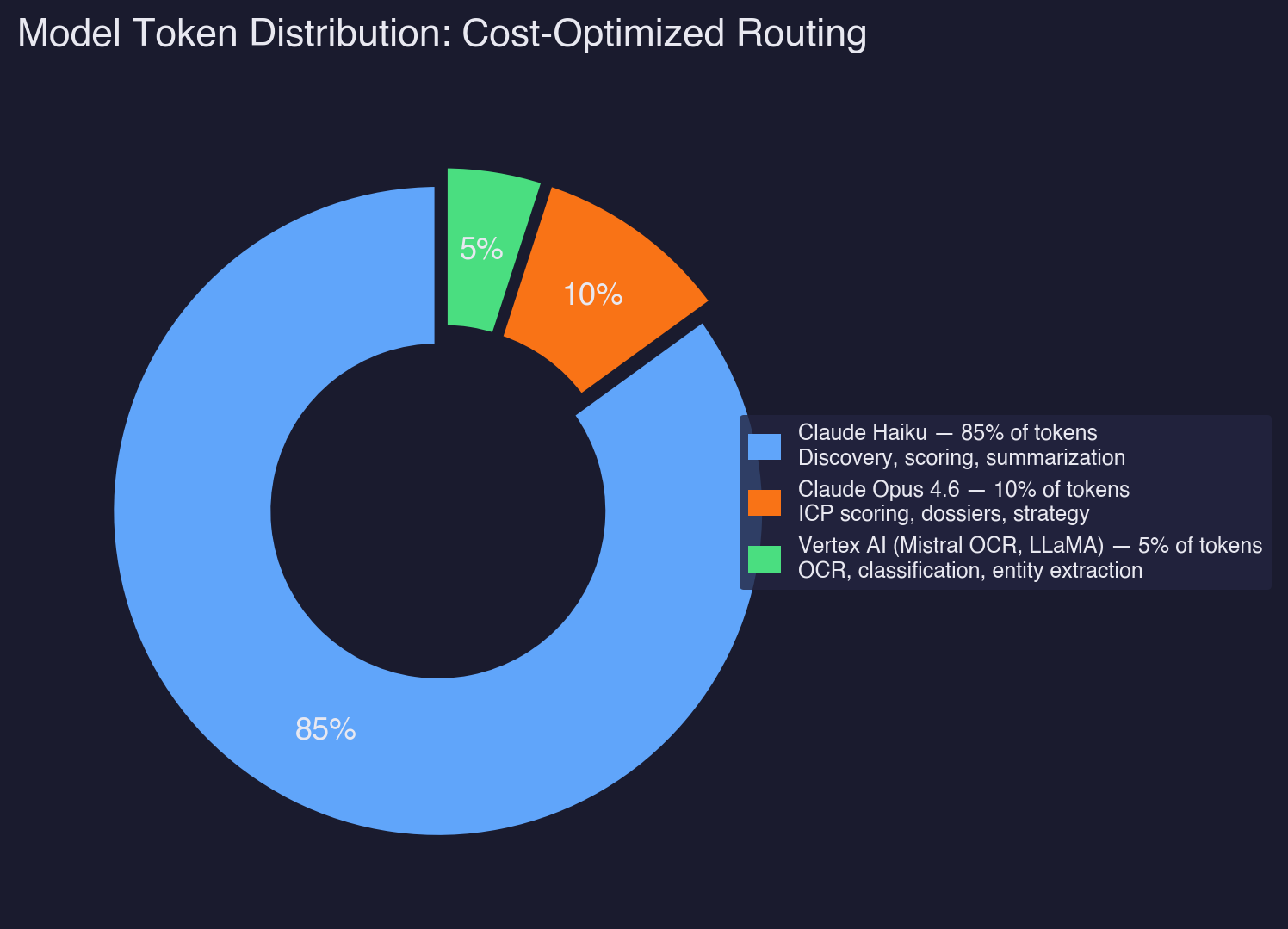
Model routing was cost-optimized across the pipeline. High-throughput, lower-stakes tasks — initial screening, web page summarization, bulk signal analysis — ran on Claude Haiku, which handled approximately 85% of the total token volume. Complex reasoning tasks — nuanced ICP fit scoring, stakeholder relationship mapping, final dossier generation — ran on Claude Opus, reserved for the stages where the quality of reasoning directly determined the quality of the output. Specialized models via Vertex AI handled document extraction and entity classification tasks where purpose-built models outperformed general-purpose LLMs at the required volume.
Budget Management
Each model had a daily token budget. When a model hit its budget, the system didn’t stop — it adapted. Tasks requiring that model were deprioritized and queued for the next budget reset or increase, while the pipeline kept running on everything else.
In practice: when the Opus daily budget was reached, high-reasoning tasks like ICP scoring and dossier generation went into the queue. Meanwhile, Haiku tasks (text analysis, summarization), web searches, and LLaMA tasks (classification, entity extraction) kept running normally. The pipeline stayed productive within budget constraints rather than going idle. When the budget reset or was increased, the queued tasks picked up where they left off.
This meant Cohost could set predictable daily spend limits without worrying about the system stalling. The work just shifted to what was affordable at that moment.
Keeping Humans in the Loop
The part of the system we spent the most time on wasn’t the contractors — it was where humans stayed in control.
We built two dedicated dashboards. The Marketing Dashboard gave Cohost’s team a real-time interface into the funnel: review prospects at each stage, approve or reject candidates, and provide qualitative feedback on dossier quality and outreach angles. The feedback from this dashboard fed directly back into the pipeline. Each cycle the team engaged with it, the system got better at predicting what they’d approve.
The Eval Dashboard was a separate internal interface for the AI team — a place to run evaluations, compare model outputs across prompt versions, and identify pipeline stages that were degrading before that degradation reached the marketing team. Quality was measured continuously, not just periodically.
Day-to-day communication ran through Slack. Escalations, alerts, and approval requests were routed to the right people using the stakeholder map — the marketing lead got notified about dossier quality issues, the sales team got prospect approval requests, and the AI team got pipeline health alerts. Different stakeholders saw different things depending on their role, so nobody was drowning in notifications that weren’t relevant to them.
We also built three reliability layers into the system itself. Context Window Rot Detection monitored for degraded output quality during long research sessions — when context utilization crossed a threshold, the system triggered a graceful checkpoint and restart rather than letting research quality silently erode. HITL Escalation automatically surfaced stuck contractors, confidence drops, or degraded quality scores to the marketing team via Slack, who could intervene directly from the dashboard rather than waiting for a bad batch to ship. And Performance Degradation Alerts ran continuous quality scoring on pipeline outputs — if any stage drifted below its quality baseline, that stage paused and routed to the eval dashboard for diagnosis before resuming.
The goal was a system the marketing team could trust without babysitting. Contractors do the research; humans approve what goes out; the system flags problems before they become costly.
Results
The team reached out to fewer prospects per week — and successful outreach increased by 430%.
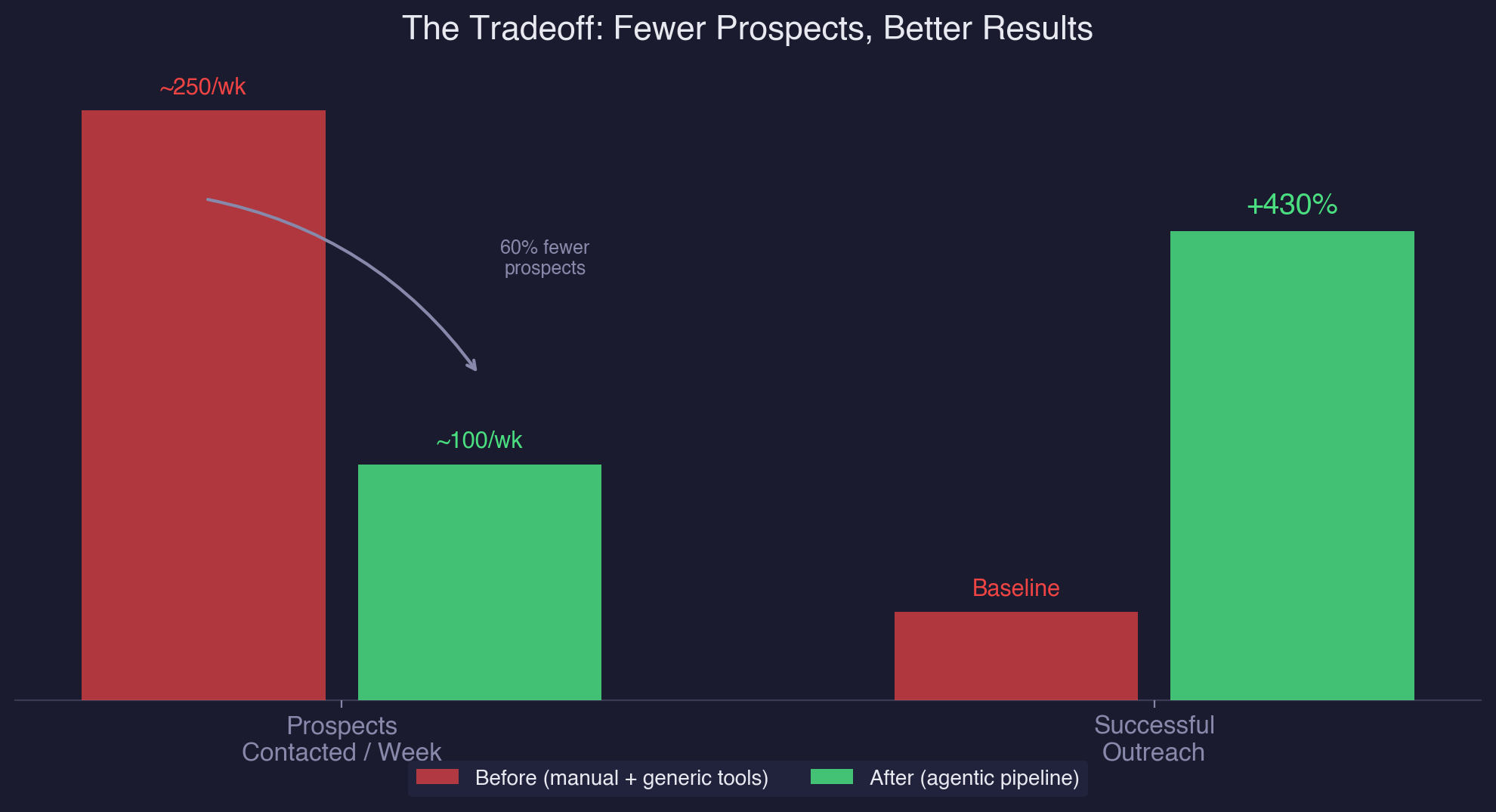
ProductiveHub’s agentic outbound pipeline achieved a 430% increase in successful outreach while contacting 60% fewer prospects — proving that AI-powered research and personalization outperforms volume-based prospecting.
That’s the tradeoff the system was designed to make. Instead of blasting a long list and hoping something stuck, the pipeline focused the team’s effort on fewer, better-researched prospects with personalized outreach strategies. The conversion rate went up because the outreach was actually relevant.
Dossier quality scores improved with each successive run as the feedback loop refined scoring weights and personalization heuristics. Prospects that previously sat untouched on a generic list were now entering the funnel with a complete research profile, a mapped stakeholder hierarchy, and a sequenced outreach strategy ready to execute.
The marketing team’s time shifted from manual research to judgment calls — reviewing and approving what the system surfaced rather than building it from scratch. Each cycle outperformed the one before it.
The Team
This project was built by a small team led by Segev, with Amit on infrastructure and pipeline engineering, Lisa on dashboard development and the feedback loop integration — and Claude, who handled everything from initial prospect research to dossier generation as the primary reasoning engine across the pipeline.
Beyond Cohost
The same pipeline shape — discover, score, research, produce a dossier, feed back what worked — applies wherever you need to find the right people and reach them with something relevant. Business development, recruiting, partnerships. The specific signals and scoring criteria change, but the architecture carries over.
Conclusion
Cohost needed better outbound. Their off-the-shelf tools weren’t producing results, and manual research couldn’t scale. We built a system that does the research automatically, keeps humans in control of what goes out, and gets better with each cycle. The marketing team went from assembling prospect lists by hand to reviewing AI-generated dossiers and approving outreach strategies — a better use of their time and a better experience for the people on the receiving end.
Related: How ProductiveHub Built an AI Engineering Team That Scales Like Infrastructure
Technology Stack
Transform Your Technology Organization
Ready to achieve similar results? Read about our fractional CTO services, or start a conversation about your engagement.
Related Success Stories
Fixing an 800% Cloud Cost Spike from Runaway Multi-Agent AI
28 days after deploying their multi-agent AI, a startup's cloud bill spiked 800%. Their agents had turned—trapped in infinite loops, generating 1.4 million zombie writes per hour. We contained the outbreak and delivered seven survival patterns.
AI Engineering Mesh: Scaling Agent Teams Like Infrastructure
A newly funded AI platform needed to ship an MVP fast — without the chaos that usually comes with 'fast.' We built a dynamically scaling mesh of Claude-powered agent clusters with a stakeholder map that knows exactly who to call, when, and why.