TL;DR.
- A fractional CTO owns the whole technology surface; a fractional CAIO owns AI as its own discipline.
- Most companies do not need two people — they need one person who can credibly own both, and a written split of decision rights.
- Hire a fractional CAIO when AI is the strategic story and the technology underneath is stable. Hire a fractional CTO when the surface is broader and AI is one of several priorities.
- A generalist CTO doing CAIO work as a side responsibility is the most common failure mode — production AI is not a side responsibility.
- Whichever shape fits, the test is whether the same person can answer both “what should the platform look like in 18 months?” and “what is our AI risk posture?” without changing tone.
The role both buyers are usually trying to describe
Founders rarely walk into the first conversation knowing which title they need. They know the problem — usually some version of “we have AI on the roadmap and nobody actually owns it” — and they reach for whichever acronym they have heard most recently. Sometimes it is fractional CTO. Sometimes it is fractional CAIO. Sometimes it is both at once, because the org chart they sketched on a napkin had a CTO box at the top and an AI lead next to it.
The acronyms are not interchangeable, but the underlying job often is. Most early-stage companies, and most operator-CEO-led companies past seed, have one person they need: a senior technology executive who can credibly own the AI strategy and the technology surface underneath it without those two halves drifting apart. The interesting question is not “CTO or CAIO.” The interesting question is whether the person you are about to hire can carry both halves at the depth you actually need.
That is what this piece is about.
What a fractional CTO owns
A fractional CTO is a senior technology executive who joins your company part-time and embedded — owning technology strategy, architecture, engineering execution, and the platform underneath the product. The role is broad on purpose. It covers the roadmap, the architecture decisions, vendor and platform selection, senior engineering hires, and the build-versus-buy calls that decide what the team is going to spend the next two quarters on.
In practice, the surface looks something like this:
- Roadmap and architecture. What we are building, in what order, on what stack, and what trade-offs that locks in.
- Engineering hiring and team shape. The senior hires, the leveling, and whether the next role is a VP of Engineering, a staff engineer, or nobody yet.
- Platform and infrastructure. The boring durable work that decides whether the next year of feature velocity exists.
- AI when it sits inside the technology stack. Which is to say: AI as one priority among many, not as the center of gravity.
A good fractional CTO covers all four. AI is in the mix, but it is one row in the spreadsheet, not the whole sheet.
What a fractional CAIO owns
A fractional CAIO (Chief AI Officer) is the same role shape — senior, embedded, part-time — but the surface is narrower and deeper. The CAIO owns AI as its own discipline: AI strategy, model and data choices, the AI systems in production, and the governance artifacts that prove the company is running AI responsibly.
The surface looks something like this:
- AI strategy. Which AI capabilities to build, buy, or sunset. Where AI creates real value, where it is a distraction, and what the next 18 months look like.
- AI systems in production. Model selection, evaluation, RAG and agent system design, output monitoring, the operational practice of keeping production AI healthy.
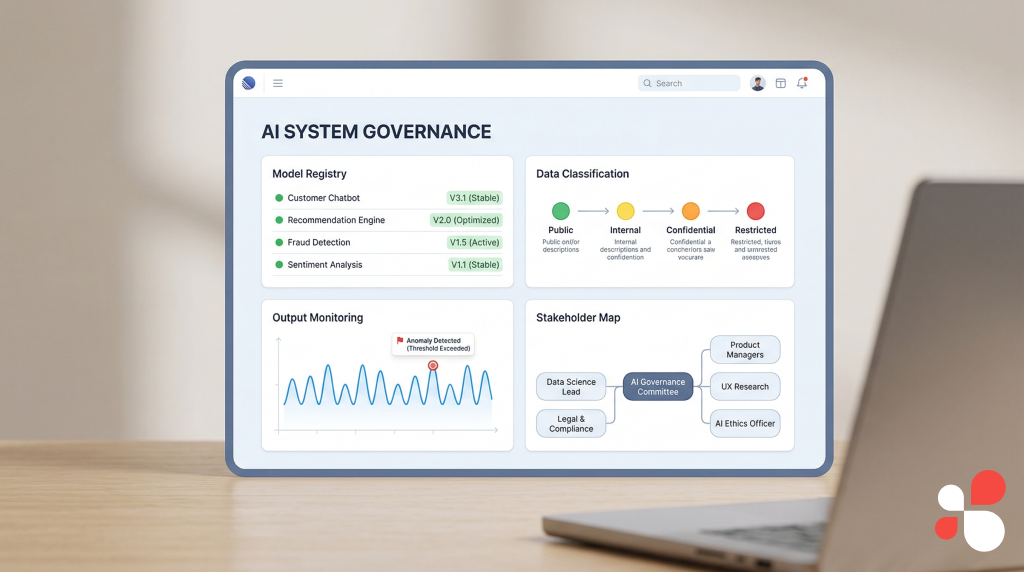
- AI governance. The artifact pack — capability map, model registry, data lineage, output monitoring, stakeholder impact, incident runbook, governance ownership — that procurement teams and auditors actually evaluate. (We have written about the framework we use.)
- AI risk ownership. A single named accountable person for AI risk in the organization. The CAIO is often that person.
The CAIO does not own the broader technology surface. They do not own platform architecture beyond AI, they do not run engineering hiring outside the AI team, and they do not own product. That is the trade-off — depth on AI, narrower scope everywhere else.
The honest comparison
| Dimension | Fractional CTO | Fractional CAIO |
|---|---|---|
| Owns | Platform, architecture, engineering, product, AI when it sits in the stack | AI strategy, AI systems, AI governance, AI risk |
| Depth on AI | High when the person is fluent in AI; thin when they are not | High by definition |
| Depth on platform / engineering | High by definition | Limited to the AI subsystems |
| Right when | Technology surface is broad and AI is one priority among several | AI is the strategic story and the platform underneath is stable |
| First-90-day output | Roadmap, architecture read, hiring plan, decision log | AI capability map, AI strategy, governance framework v1 |
| Risk if you pick wrong | AI gets owned as a side responsibility and quietly drifts | Platform debt accumulates while AI gets all the attention |
The two roles share the executive shape, the embedded model, and the part-time cadence. They differ on what the person is fluent in and what they own.
When to hire a fractional CAIO instead of a fractional CTO
Four signals push toward CAIO over CTO. Any one of them is enough to consider it; two or more is decisive.
- AI is the central strategic story. Not a feature. Not a roadmap line item. The center of how the company plans to win.
- The platform underneath is reasonably stable. Engineering is not the bottleneck. The team can ship. The question is what to ship in AI, not whether the platform will hold up.
- The questions you cannot answer are AI-shaped. Which models. Which data. Which governance posture. How to convince enterprise procurement that the AI is safe.
- There is already a CTO or strong VP of Engineering in place. The technology surface has an owner. What is missing is the AI counterpart.
If three or four of these are true, the role you are hiring for is CAIO, not CTO. Hiring a generalist fractional CTO into that situation is over-broad — you do not need them to own platform decisions an existing leader is already owning.
When to hire a fractional CTO instead of a fractional CAIO
The mirror image. Three signals push toward CTO over CAIO.
- The technology surface is broader than AI. Platform debt, architecture decisions, engineering hiring, infrastructure are all on the table. AI is one of several priorities.
- There is no senior technology owner already in place. A CAIO can run AI, but they cannot fill the CTO seat at the same time. If the CTO seat is empty, fill it first.
- The AI work is real but fits comfortably inside the wider technology engagement. Maybe two AI features. Maybe the start of a governance framework. Not “this is the company now.”
If those describe the situation, hire a fractional CTO who is genuinely fluent in AI. Most are not. Hire carefully.
The CTO+CAIO engagement: one person, two hats, written rules
For most early-stage and mid-market companies, the best answer is a single embedded executive who can credibly carry both hats — and a written agreement on which hat is on for which decision.
This works when three things are true:
- The person has real production AI depth. Not “I have read about RAG.” Real model selection trade-offs, real evaluation frameworks, real governance artifacts shipped to real procurement teams. The CAIO half is not a side responsibility; either the executive can do it at depth, or the engagement should be split into two people.
- Decision rights are written down. Architecture decisions belong to the CTO hat. AI risk ownership belongs to the CAIO hat. Hiring decisions for the AI team are joint. Spending limits per hat are agreed up front. When the rules are written, the person can context-switch cleanly; when they are not, the same person quietly defaults to whichever hat they are more comfortable wearing, and the other half drifts.
- The output is split visibly. A CTO+CAIO engagement should produce two distinct deliverables in the first quarter: the technology read (CTO hat) and the AI capability map plus governance framework v1 (CAIO hat). When they are bundled into a single document, the CAIO half tends to get thinner by the page.
Done well, the CTO+CAIO model is faster, cheaper, and produces fewer interface bugs than running the two roles as separate hires. Done badly — by a generalist CTO who took the CAIO label as a marketing exercise — it is the most expensive way to get neither role done well.
This is the engagement shape we run most often, and it is what our fractional CTO services are built around. Real fractional CTO services that include CAIO depth, not as a side responsibility, but as the other half of the same job.
Three failure modes worth naming
A few patterns to watch for, drawn from engagements that started somewhere else.
The CTO who quietly drops the AI half. Fluent on platform, vague on AI strategy, defaults to “we will pick a model when we need to.” The org has a CTO box filled, but the CAIO box is empty and nobody noticed. Most common when the CTO was hired before AI became the central story.
The CAIO with no platform credibility. Fluent on models, vague on engineering. The AI strategy is excellent on paper and impossible to ship because the platform underneath cannot support it. Most common when the CAIO was hired into a company that did not have a CTO yet, and the AI roadmap quietly assumed engineering capacity that did not exist.
The two-person setup that interfaces badly. A separate CTO and CAIO, both senior, both embedded, both writing strategy in parallel. Decision rights drift, the engineering team gets contradictory guidance, the AI team gets blocked by platform calls the CAIO cannot make. Most common when both hires were made by the same CEO in the same quarter, before the org was big enough to actually need two people.
Practical decision: ask the four questions
When you are deciding between a fractional CTO, a fractional CAIO, or a CTO+CAIO engagement, the four questions that cut through most of the noise:
- Is AI the strategic story, or one of several priorities? Strategic story → lean CAIO. One of several → lean CTO with AI fluency.
- Is the platform underneath the AI work stable, or is it the bottleneck? Stable → CAIO. Bottleneck → CTO.
- Is there already a senior technology owner in place? Yes → add CAIO. No → start with CTO.
- Do you need the same person making AI risk decisions and platform decisions? Yes → CTO+CAIO engagement. No → two roles.
The answers do not always agree. When they do not, weight question 4 highest — interface friction between separate CTO and CAIO roles is the failure mode that most consistently destroys the value of either hire.
Where this lands
For most companies under Series B with AI in the strategy, one embedded executive who can credibly own both hats is the right answer. The role label is less important than the depth on each side and the written split of decision rights between them.
If that describes where you are, the fractional CTO services we run are designed around that exact shape: senior technology ownership and AI ownership, in the same person, with the rules of the engagement written down.
The first conversation is worth having even if the answer turns out to be “you need a CAIO with no CTO” or “you are closer than you think and do not need either of us long-term.” That answer costs nothing to find out, and you walk away with a written read of which hats actually need filling.
How to choose between a fractional CTO and a fractional CAIO
What is a fractional CAIO?
A fractional CAIO (Chief AI Officer) is a senior AI executive who joins your company on a part-time, embedded basis to own AI strategy, AI governance, and the AI systems themselves. The role is narrower than a CTO's but deeper inside AI: it covers which AI capabilities to build versus buy, how to ship them safely into production, the governance evidence procurement teams ask for, and the operational practice of running AI in a real business.
What's the difference between a fractional CTO and a fractional CAIO?
A fractional CTO owns the broader technology surface — platform, architecture, engineering, product, and yes, AI when it sits inside the technology stack. A fractional CAIO owns AI as its own discipline: AI strategy, AI governance, model selection, AI risk ownership, and the AI systems in production. A CTO who is fluent in AI can carry CAIO responsibilities; a CTO who is not will quietly drop them, and you will not notice until the procurement conversation stalls.
Do I need both a fractional CTO and a fractional CAIO?
Most companies do not need two separate people. They need one person who can credibly own both surfaces, and they need a written agreement on which decisions belong to which hat. The two-person setup tends to work for larger organizations where AI is already a major P&L line; for everyone else, a CTO+CAIO engagement run by one accountable executive is faster, cheaper, and produces fewer interface bugs between strategy and execution.
When should I hire a fractional CAIO instead of a fractional CTO?
Hire a fractional CAIO when AI is the strategic story, the technical platform underneath it is reasonably stable, and the questions you cannot answer are AI-shaped: which models, which data, which governance posture, how to ship AI features that pass enterprise procurement. Hire a fractional CTO when the technology surface is broader than AI — platform debt, architecture decisions, engineering hiring, infrastructure — and AI is one of several priorities rather than the central one.
Can the same person do both fractional CTO and fractional CAIO work?
Yes, when the person actually has the depth to do it. The CAIO half requires real production AI experience: model selection trade-offs, RAG and agent system design, AI evaluation frameworks, governance artifacts that procurement teams accept. A generalist CTO doing CAIO work as a side responsibility is a common failure mode — the strategic decisions look fine on paper and quietly miss the things that only show up at production scale.
What does a fractional CAIO deliver in the first 90 days?
A typical first 90 days produces three things: an AI capability map of what is running today and what it costs in compute, vendor fees, and risk; an AI strategy document that says which capabilities to build, buy, or sunset over the next year; and the first cut of a governance framework — the artifacts, the named owner of AI risk, and the operational rituals that keep the framework current. Whether it is a CAIO or a CTO+CAIO engagement, those deliverables are the floor.